
Choose the Right Flute (Bansuri)
A complete scale selection guide tailored for children, teenagers, and adults
"Which flute should I start with?"
One of the most common questions every beginner asks! Choosing the right flute is important because it can make your learning journey much more comfortable and enjoyable. The recommendations below are based on practical learning experience and are intended to help beginners make an informed choice.
1. Buy a Good Quality, Tuned Flute
Before choosing a scale, make sure you buy your flute from a reputable and professional flute maker. A well-crafted, properly tuned flute will produce better sound, be easier to play, and help you develop good technique right from the beginning.
Why visit a local flute maker or music store in person?
Whenever possible, visit a local flute maker or music store instead of buying online. This allows you to:
- Check whether the flute is properly tuned (A440 Hz standard).
- Test how comfortable it feels in your hands and fingers.
- Get guidance on selecting a flute based on your blowing strength & finger reach.
- Receive practical recommendations from an experienced flute craftsman.
💡 If you're a complete beginner, don't worry—flute craftsmen can usually suggest the most suitable starter scale (such as C Medium or G Base) to match your finger span and blowing comfort.
Recommended Flute Scales
👦 Children
These flutes are smaller in length, lighter, and much easier for young children to hold, blow, and play comfortably without stretching fingers.
🧒 Children & Teenagers
Choose the scale that feels more natural based on hand size, finger stretch flexibility, and overall comfort while holding the flute.
👨 Adults
For most adult learners, the G Base flute is the ideal starting instrument. It provides comfortable finger spacing while producing a warm, rich, and beautiful bass tone.
📷 Comparing the Scales & Sizes
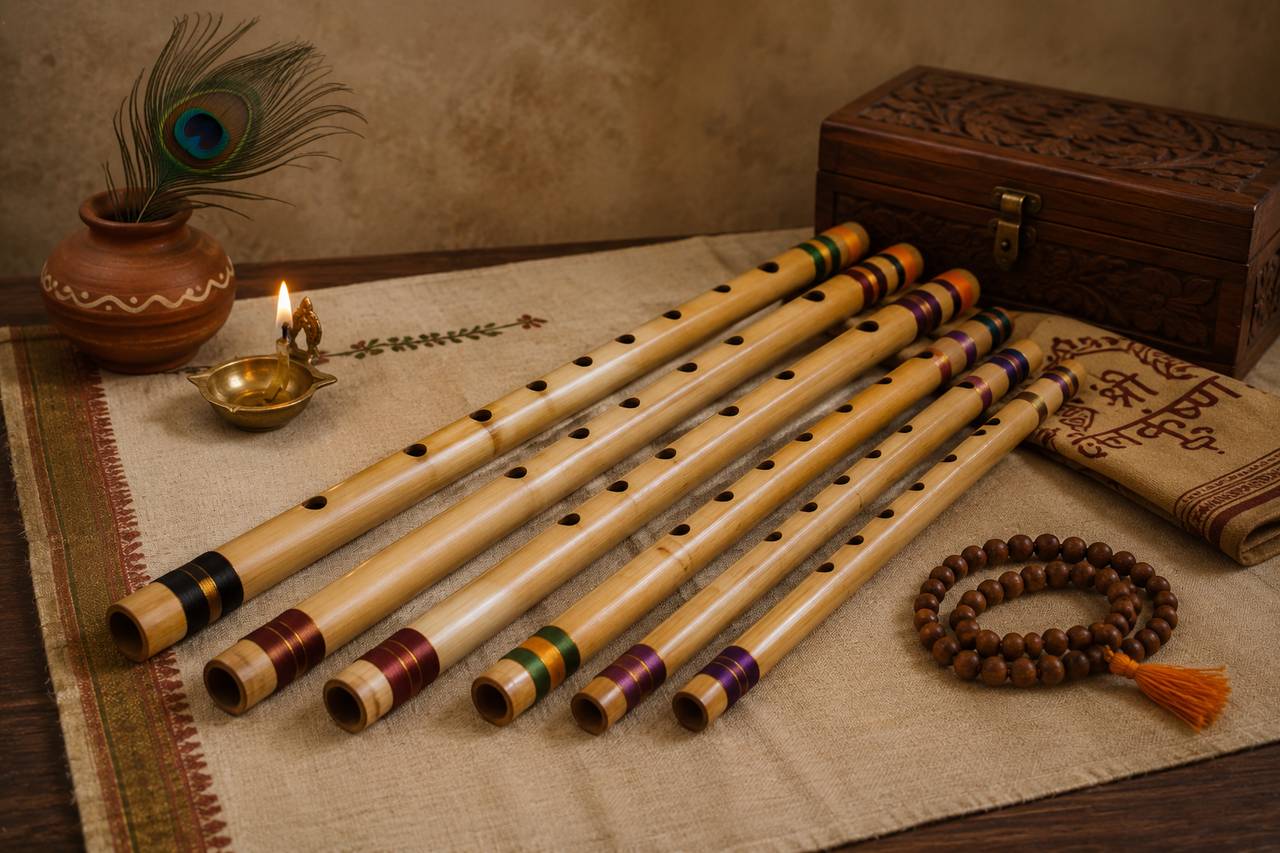
Flutes Visual Reference Guide:
Bansuri Materials, Finger Stretch Test & Quality Inspection
Assam Bamboo vs. PVC / Synthetic Flutes: Which Should You Choose?
Natural seasoned Assam bamboo produces warm, organic resonance and sweet upper harmonics. Because the wood is porous, it absorbs condensation and vibrates freely against the lips. However, it requires care: avoid extreme heat, direct sunlight, and dry winter air without oiling.
- • Pros: Unmatched tonal depth, authentic Indian classical timbre, lightweight.
- • Cons: Susceptible to humidity cracks if neglected.
Precision-molded PVC flutes are completely unaffected by weather, drops, rain, or arid air. Their pitch remains identical in summer heat and winter frost. While the tone is slightly brighter and less "woody," a tuned PVC bansuri is a fantastic, stress-free starter instrument.
- • Pros: 100% crack-proof, washable with water, highly budget-friendly.
- • Cons: Slightly sterile resonance compared to aged organic bamboo.
The "3-Knuckle Stretch Test" (Check Your Hand Compatibility)
Before purchasing a large bass bansuri (like E Bass or D Bass), measure your finger span. Lay your right hand flat on a table with fingers slightly spread. Measure the distance between the center pad of your index finger and the center pad of your ring finger:
5-Point Pre-Purchase Flute Inspection Checklist
- Check Cylindrical Straightness: Hold the bansuri up to one eye and look down its length like an arrow. It should be virtually straight with no noticeable bends or oval warping.
- Wall Thickness Uniformity: The bamboo wall at the blow-hole and bottom end should be approximately 1.8mm to 2.5mm. Walls that are too thin sound shrill; walls that are too thick require excessive blowing force.
- Cork Seal Position: The cork plug inside the headjoint should sit approximately one inner-diameter length away from the blow-hole center and must be air-tight.
- Clean Tone-Hole Edges: The inside edges of finger holes should be gently beveled with fine sandpaper, free from splinters or charred burn burrs.
- Tightly Bound Threads: Nylon or silk threading should be wound with firm tension around critical stress zones (top, bottom, and between upper holes) to protect against longitudinal cracking.
Understanding Indian Sa vs. Western Key Nomenclature
A common point of confusion for beginners is how flute makers name keys. In Indian classical music, the key of a bansuri is named after the pitch produced when the upper 3 holes are closed (which is Middle Sa). For example, on a "C Natural Medium" bansuri, closing 3 holes produces Western C4. In Western woodwind terminology, however, instruments are named after closing all 6 holes (which on the same flute produces Western G3). Always confirm with your flute maker that you are ordering by Indian 3-hole Sa!
⚠️ Important Note
These scale recommendations are general guidelines, not strict or unbreakable rules!
Every person's hands are different. Finger length, palm size, flexibility, and physical comfort all play an important role in choosing the right flute. If a recommended flute feels difficult to hold or cover properly, it's perfectly fine to choose another scale (such as E Bass or B Base) that suits your hands better.
✨ Remember: The best flute is the one that allows you to play comfortably and enjoy your practice session every day.
Final Tip for Beginners
Don't spend too much time worrying about finding the "perfect" flute. Start with a good-quality, tuned flute that feels comfortable in your hands, practice consistently, and focus on building strong fundamentals (blowing & finger grip). As your skills improve, you can always explore flutes in different scales to expand your musical journey!
About the Author
Written and practice-tested by Aplut, a self-taught bansuri learner practising since 2022. Content is built on direct practice experience and careful research into classical traditions. Because musical lineages and fingering conventions vary, suggestions and corrections are always welcomed via our contact page or at aplut0006@gmail.com. First-hand instrument experience is identified clearly whenever gear is reviewed.